The global demand for plant-based skincare ingredients is reshaping how brands evaluate active suppliers. Plant Retinol Bakuchiol Bak is gaining attention because it connects botanical sourcing with modern cosmetic formulation. Yet the name can create confusion. Some suppliers use different grades, extraction methods, or marketing descriptions.
This guide examines leading Plant Retinol Bakuchiol Bak suppliers worldwide through practical quality indicators. These include botanical identification, extraction transparency, batch consistency, and documented testing. Reliable suppliers should provide certificates of analysis, allergen information, heavy metal results, and stability data. GMP-aligned production also supports safer and more consistent cosmetic development. Look closely.
A strong supplier can explain where the plants grow, how they are processed, and how active content is measured. Clear traceability matters when a small amber bottle represents months of formulation work. Technical support is valuable, especially for emulsions, serums, and sensitive-skin products. However, supplier claims should not be accepted without verification. Independent testing may still be necessary.
This overview does not treat “top” as a permanent ranking. Performance depends on application, dosage, documentation, delivery capacity, and regional compliance requirements. Some suppliers may have excellent laboratory data but limited production scale. Others may offer dependable volume while providing less detailed technical guidance. That difference deserves attention. Careful comparison helps buyers choose partners with credible evidence, responsive communication, and realistic quality commitments.
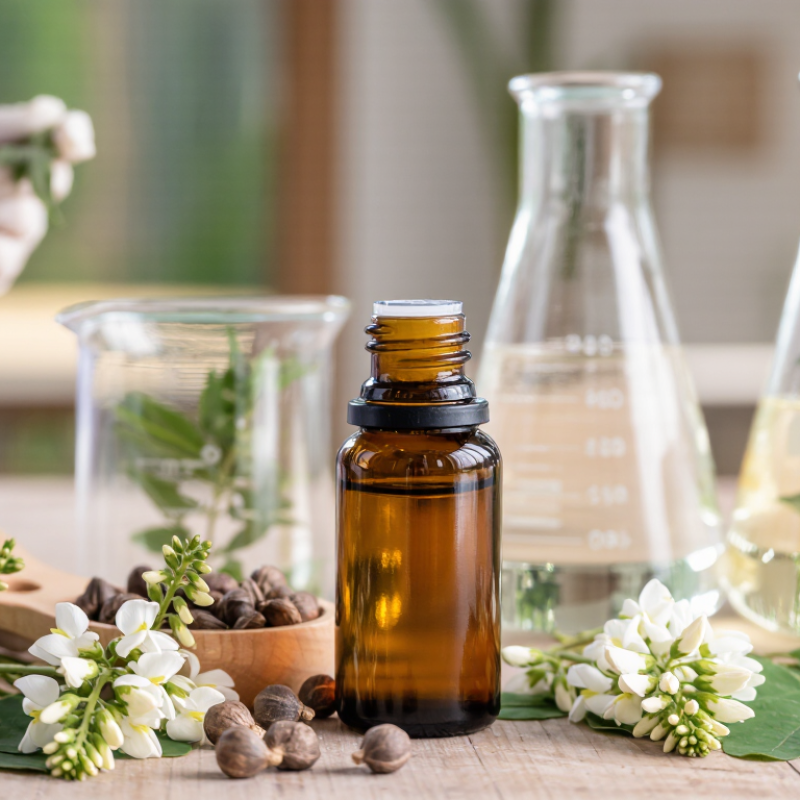
Bakuchiol’s botanical identity begins with Psoralea corylifolia, a small legume traditionally used in Asian botanical practice. Its seeds contain bakuchiol, a meroterpene with retinol-like cosmetic interest. The plant is not retinol, however. Retinol is a vitamin A derivative, while bakuchiol is plant-derived and chemically different. That distinction matters during supplier evaluation.
A 2019 randomized, double-blind clinical study in the International Journal of Cosmetic Science followed 44 participants for 12 weeks. Daily bakuchiol and retinol preparations produced comparable improvements in wrinkles and pigmentation. The bakuchiol group reported less scaling and stinging. The sample was modest. More research is still needed. Laboratory similarity does not guarantee identical skin results.
Market data also shows growing commercial attention. Grand View Research valued the global natural cosmetics market at approximately USD 35.87 billion in 2023. It projected a 5.2% compound annual growth rate from 2024 to 2030. This growth increases demand for reliable botanical suppliers, but volume alone proves little. Buyers should request Psoralea corylifolia authentication, bakuchiol assay results, residual solvent testing, and stability data. A clear certificate of analysis should identify the extraction method and batch number. Crude powders, pale amber oils, and refined extracts can behave differently in a finished formula. That detail is easy to overlook. Sustainability claims also deserve scrutiny, because cultivation, traceability, and processing conditions can change the ingredient’s environmental profile.

Bakuchiol is increasingly selected for plant-based retinol alternatives, but cosmetic quality depends on more than botanical origin. A pale, clear sample may still contain residual solvents, oxidation products, or diluted active matter. For many professional buyers, a ≥98% HPLC assay is a practical benchmark for concentrated cosmetic-grade bakuchiol. It signals stronger identity control, not automatic product safety.
HPLC testing should be supported by a certificate of analysis, chromatogram, batch number, and test method. Buyers should also review residual solvents, heavy metals, microbial limits, water content, and storage conditions. ISO 16128 can help describe natural-origin content, but it does not confirm purity or performance. A supplier claiming “98%” without chromatographic evidence deserves careful questioning. Small details matter.
Published clinical evidence remains limited but useful. A 2018 study in the International Journal of Cosmetic Science followed 44 participants for 12 weeks, using 0.5% bakuchiol or retinol formulations. Both groups showed improvements in wrinkles and pigmentation, while the bakuchiol group reported fewer irritation reactions. This was not a large trial. It should not be treated as final proof. Industry quality reports, including recent cosmetic ingredient testing summaries, repeatedly emphasize method validation and batch consistency. In practice, I would compare at least three consecutive lots, inspect HPLC peak purity, and request stability data at room temperature and accelerated conditions. “Plant-based” sounds reassuring, but analytical discipline remains essential.
Clinical evidence matters more than supplier rankings in plant-based retinol alternatives.
A randomized, double-blind clinical study published in the International Journal of Cosmetic Science tested 0.5% bakuchiol against 0.5% retinol for 12 weeks. The trial included 44 participants. Both groups showed visible improvements in facial wrinkles and uneven pigmentation.
The details are important. Bakuchiol produced comparable results, while participants using retinol reported more scaling and stinging.
Not painless.
The study was relatively small, and 12 weeks cannot predict long-term performance. The Cosmetic Ingredient Review’s safety assessment also supports careful formulation and exposure evaluation, rather than treating “natural” as automatically gentle. Professional buyers should request identity testing, HPLC assay results, residual-solvent data, microbiological limits, and accelerated stability records. A reliable global supplier should disclose the botanical source, extraction method, batch traceability, and active-content range. Supplier claims alone are weak evidence. Test the finished formula under real storage conditions, including heat and light. Bakuchiol can support a sensitive-skin positioning, but its performance still depends on concentration, delivery system, and daily use.
When reviewing top plant retinol and bakuchiol suppliers worldwide, quality begins with traceable evidence. A clear Certificate of Analysis should identify the botanical source, batch number, assay result, test methods, and manufacturing date. It should also show specification limits, not only average values. Missing details create avoidable doubt.
HPLC testing deserves close attention. The report should name the column, detector, reference standard, retention time, and tested concentration. For bakuchiol, HPLC can help confirm identity and measure purity. A supplier may report 99% purity, yet provide no chromatogram. That is a weakness. Ask for raw data or an independent laboratory report when the application is sensitive. Numbers alone are not enough.
Residual solvent testing should match the extraction process. A credible COA lists each targeted solvent and its result, preferably with the detection limit. “Complies” is less useful than a measured value. Microbial limits also need practical detail, including total aerobic count, yeast and mold, and specified pathogens. Sampling conditions matter. I have seen technically neat documents with unclear sampling plans, which deserves further review. Supplier audits should examine sealed drums, storage temperature, tamper evidence, and batch-to-batch consistency. One overlooked issue is document timing: a recent COA may not represent the delivered lot. Verification must follow the actual batch.
Supplier-neutral quality review framework for plant-derived bakuchiol. Acceptance criteria should be agreed for the material grade, intended use, manufacturing process, and applicable market requirements.
| Quality Dimension | What to Review | Evidence or Test Method | Review Guidance |
|---|---|---|---|
| Certificate of Analysis (COA) | Product name and grade, batch or lot number, manufacturing and retest or expiry dates, test results, units, specifications, and release status. | Batch-specific, authorized COA; confirm the lot number matches the shipped material and that results are reported against defined methods and limits. | Check that the COA is complete and traceable. A generic specification sheet is not a substitute for batch-specific test results. |
| Identity | Confirmation that the material is bakuchiol and is consistent with the declared source and grade. | Fit-for-purpose identity testing, such as comparison by HPLC with an appropriate reference standard; FTIR or another orthogonal technique may provide additional confirmation. | Review the method, reference standard, and acceptance criteria. Identity should not be inferred from a trade description alone. |
| HPLC assay and chromatographic profile | Assay or chromatographic purity, related peaks, and relevant impurities specified for the material. | HPLC chromatogram and test report showing the method, reference standard, calculation basis, and results. Confirm that the method is validated or verified for its intended use. | There is no single universal assay limit for every bakuchiol grade. Set and review limits in the approved specification; do not treat a marketing claim as a batch result. |
| Residual solvents | Solvents used or reasonably expected from extraction, purification, or processing. | Process-based solvent list and, where needed, GC-FID or GC-MS results with the method, reporting limit, and units stated. | Assess results against the agreed raw-material specification and applicable regulations. ICH Q3C provides solvent guidance for pharmaceuticals; its limits are not automatically universal cosmetic raw-material limits. |
| Microbial quality | Total aerobic microbial count, yeast and mould count, and specified objectionable microorganisms, as relevant to the material and intended product. | Microbiological test report from a suitable method, with sample amount, units, detection limits, and specified-organism results. | Set raw-material limits through a documented risk assessment and applicable requirements. ISO 17516 gives limits for finished cosmetics, not a universal specification for every ingredient. |
| Finished-cosmetic microbial reference | Where relevant, consider the intended finished-product category when establishing controls. | ISO 17516:2014 classifies finished cosmetics as Category 1 (products for children under three, the eye area, or mucous membranes) and Category 2 (other products). | For finished products, the standard specifies total aerobic mesophilic microorganism limits of 10² CFU/g or ml for Category 1 and 10³ CFU/g or ml for Category 2, with specified microorganisms absent in 1 g or 1 ml. These figures should not be applied directly as ingredient limits. |
| Physical and handling characteristics | Appearance, colour, odour, and any other agreed physical attributes. | COA results and documented incoming inspection under defined conditions; compare with an approved reference or specification. | Record deviations and investigate changes between lots. Appearance and odour are useful checks but do not replace analytical identity or purity testing. |
| Traceability and change control | Raw-material origin, manufacturing site and process controls, batch traceability, and notification of material or process changes. | Supplier quality documentation, lot records, change-control procedure, and a current specification revision. | Confirm that changes affecting identity, composition, impurities, or test methods are communicated and assessed before use. |
Interpretation note: This table is a supplier-evaluation framework, not a universal product specification or a claim about any individual supplier. Agree numerical acceptance criteria with the supplier and assess them against the intended application and applicable local requirements.
For worldwide procurement of plant-based retinol alternatives, bakuchiol suppliers should be assessed beyond price. ISO 16128 can help verify natural-origin calculations, but it is not a safety certificate. Ask for the exact calculation method and supporting raw-material records. A reliable supplier should provide batch numbers, country of cultivation, harvest dates, and processing locations. These details make a small vial traceable back to its botanical source.
Extraction method deserves close attention. Ethanol extraction, supercritical carbon dioxide, and other processes can produce different color, odor, purity, and residual profiles. Request the solvent specification, purification steps, assay method, and recent certificate of analysis. Compare samples under identical conditions. One sample may look cleaner but perform less consistently in a finished formula. That part is often underestimated.
Tips: Start with a practical MOQ. Request a laboratory sample before committing to commercial volume. Confirm whether the MOQ applies per batch, per specification, or per shipment. Check lead times for seasonal crops, and ask how rejected batches are handled. Keep written records of every change. Suppliers sometimes describe ISO alignment too broadly, and buyers can miss this wording. I have found that a clear specification sheet prevents more problems than an attractive technical presentation. Small gaps matter.